
Industries
Automotive electronics
Under-bonnet heat, fuel and fluid exposure, salt spray, condensation cycling and constant vibration — automotive is the environment that finds every weakness in a coating specification.
What the environment does
The stresses that decide the specification
Thermal cycling, not just temperature
An engine-bay assembly swings from ambient to well above 100 °C and back, thousands of times over its life. Each cycle drives differential expansion between the coating, the laminate and the solder joints. A film that goes hard and brittle transfers that stress straight into the fillets; a flexible one absorbs it.
Fluids and vapours
Fuel, engine oil, brake and transmission fluid, screen wash, battery electrolyte and workshop cleaning chemicals all reach electronics that were never meant to meet them. This is the exposure acrylic chemistry cannot survive and polyurethane was made for.
Salt, humidity and condensation
Coastal operation and monsoon humidity mean repeated condensation on a cold board in warm wet air. That cycle finds every pinhole and every thin edge, which is why coverage verification matters at least as much as material choice.
Continuous vibration
Road-induced vibration runs for the life of the vehicle. It argues for a coating that stays elastic, and it raises the cost of any coating defect that concentrates stress at a joint.
EV-specific stress
Traction inverters, BMS boards and on-board chargers combine high voltage with high heat density. Creepage and clearance are being managed at the same time as thermal load, and the coating is part of both calculations.
Coating systems
What is typically specified here
Sector convention is a starting point, not an answer — the environment specification decides. Our engineers will confirm the grade against your actual assembly.
Polyurethane (UR)
The default for under-bonnet and fluid-exposed assemblies: excellent resistance to fuels, oils, solvents and abrasion, with a strong moisture barrier.
Silicone (SR)
Where high temperature and thermal cycling dominate over chemical attack — power electronics, assemblies mounted close to heat sources, anything cycling hard.
UV thick-film (DSL)
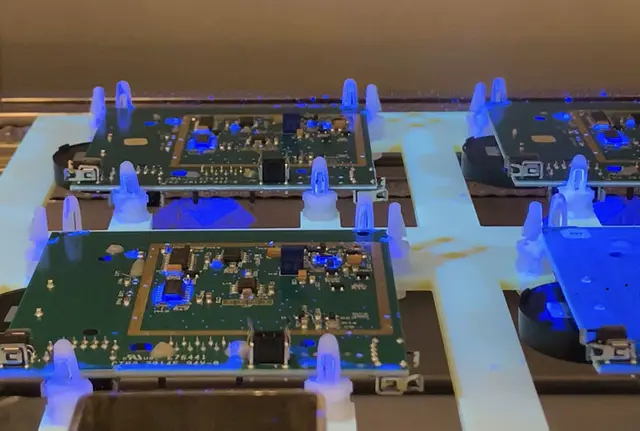
High-volume repeat production on selective coating lines, where seconds-fast cure removes the coating step from the critical path.
Full comparison: acrylic vs polyurethane vs silicone · Selection method: how to choose a conformal coating
ESD packing
Getting the assembly there intact
- Static shielding bags for ECUs and sensor modules moving between tiers.
- Aluminium moisture barrier bags with desiccant for moisture sensitive devices and export consignments.
- ESD thermoformed trays with cavities matched to connector geometry, so modules cannot shift in transit or in automated handling.
- Returnable PP corrugated bins and dividers for shop-floor circulation between plants.
Standards
What gets specified
Automotive programmes usually specify IPC-A-610 Class 2 acceptance, with Class 3 invoked for safety-critical control. Coating material is qualified against IPC-CC-830B. Expect the OEM or tier-one customer to layer their own specification on top — read it before quoting, because it almost always tightens something. The Peters ELPEGUARD and ELPECAST ranges EMS supplies are approved by the automotive industry.
Standards explainerFrequently asked
Automotive electronics questions
What is the best conformal coating for automotive PCB assemblies?
Polyurethane is the usual answer for under-bonnet and fluid-exposed assemblies, because fuel, oil and cleaning chemicals are precisely what it resists. Silicone is preferred where the dominant stress is high temperature, thermal cycling or vibration rather than chemical attack — power electronics and assemblies mounted near heat sources. The environment specification, not the sector label, should make the choice.
Does EMS coat automotive assemblies on site?
Yes. EMS deploys 30+ trained engineers to run the agreed coating process on site at customer facilities across India. For automotive volumes, selective coating integrated into the line is usually the lower-cost route once masking labour is counted honestly.
What coating is used for EV power electronics?
Traction inverters, BMS boards and on-board chargers combine high heat density with high voltage, which typically points to silicone for its temperature range and flexibility, or to a polyurethane system where fluid exposure is also present. Because creepage and clearance are being managed alongside thermal load, the coating specification should be reviewed with the isolation design rather than after it.
Coating for automotive electronics?
Send us the assembly, the environment it has to survive and the standard you are working to. Our engineers come back with a coating system, an application method and a window.